
Most vitamin C serum reviews read the same way. Person buys it. Person notices a glow. Person says they will never go back. What those reviews skip is everything that happens in the middle, and everything that determines whether you are the person who gets that glow or the person who uses half the bottle and quietly puts it in a drawer. I have spent time with The Ordinary Ascorbyl Glucoside Solution 12% on my own face, specifically on combination skin with a handful of shallow post-blemish marks on my forehead and cheeks, and I want to tell you what the algorithm buries.
The short version: this is a genuinely useful brightening serum for people who match a specific profile. It is not the right vitamin C for everyone, and the budget price tag does not mean it is a safe, low-stakes experiment for every skin type. This review is about the honest details.
The Quick Verdict
A stable, low-irritation vitamin C worth the price, but slower than most reviews suggest and not suited for those chasing rapid dark-spot correction.
Amazon Check Today's Price →If your only vitamin C concern is budget, stop reading and check today's price. If you want to know whether it will actually work for your skin first, keep going.
The Ordinary Ascorbyl Glucoside Solution 12% is currently available on Amazon. It ships with Prime and costs less than most SPFs you already own.
Amazon Check Today's Price on Amazon →The Ingredient Reality Most Reviews Skip
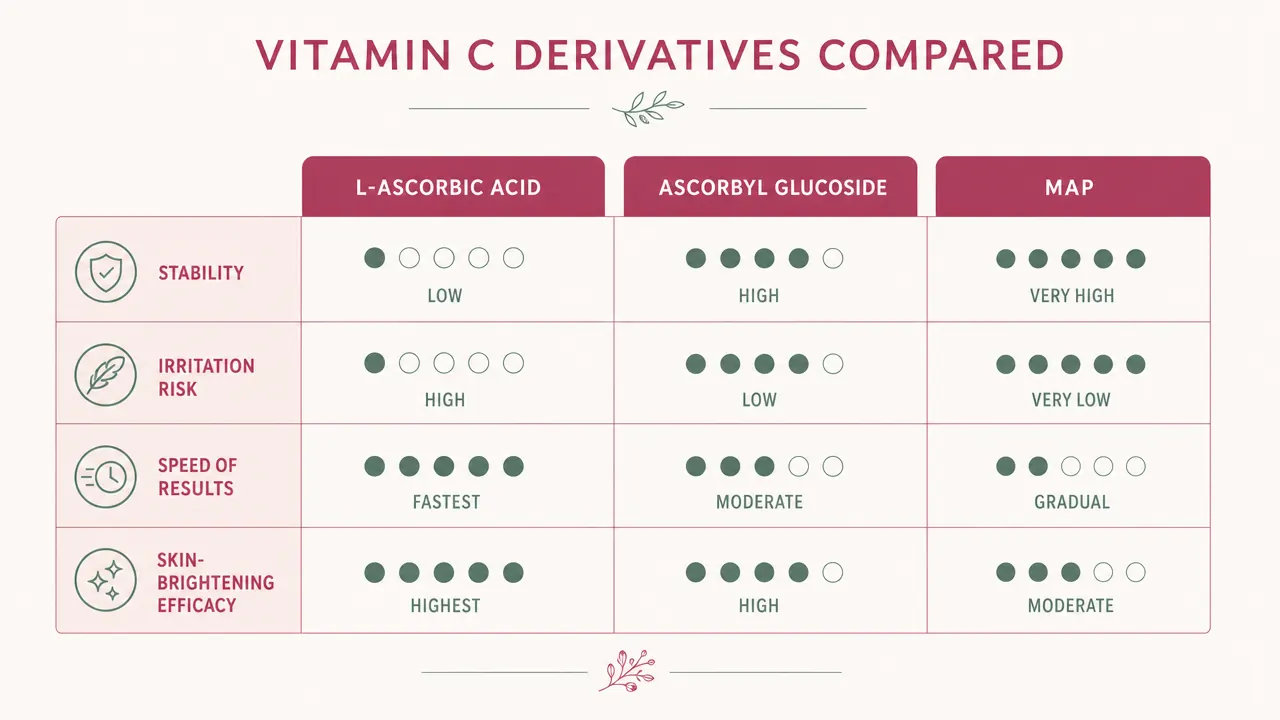
Vitamin C is not a single ingredient. This is the fact that trips up most people who buy based on the category alone. The most-studied form is L-ascorbic acid, which penetrates quickly and delivers faster results on hyperpigmentation, but is notoriously unstable (it oxidizes in weeks), requires a low pH formulation that can sting sensitive skin, and needs careful storage away from light and air. The Ordinary uses a different form in this serum: ascorbyl glucoside, a water-soluble vitamin C derivative that is stabilized by attaching a glucose molecule to the ascorbic acid structure. The stability advantage is real and measurable. The tradeoff is conversion speed. Ascorbyl glucoside must be converted back to L-ascorbic acid by skin enzymes after absorption. That extra step means results take longer to appear.
This is not a flaw specific to The Ordinary. It is an inherent property of the derivative. You are choosing between a fast-acting, high-irritation option (pure ascorbic acid) and a slow-acting, low-irritation option (ascorbyl glucoside). For people with reactive, redness-prone, or barrier-compromised skin, that tradeoff is the right one. For people expecting month-one dark spot correction, this serum will disappoint and the reviews will have misled them.
At 12%, the concentration sits at the mid-range for this derivative. The formula is water-based, lightweight, and fragrance-free. The pH lands at approximately 6 to 7, which is close to skin's natural pH and explains the low sting rate. The other ingredients in the formula are minimal: water, propanediol, and a small supporting cast. There is no niacinamide (a point worth noting if you are considering stacking), no vitamin E, and no ferulic acid to boost antioxidant synergy.
What My Skin Actually Looked Like After Eight Weeks
I applied this serum each morning to clean, dry skin on my forehead, cheeks, and the outer corners of my jaw, where I carry two faint dark marks from blemishes that healed in early spring. I followed it immediately with SPF 50. No other actives in my morning routine. My skin at baseline was calm, combination, no active breakouts, and the marks I was tracking ranged from light tan to slightly pink.
By week six, one of the two marks I was tracking had faded noticeably. The other one, which sat deeper in the skin, looked about the same. That is probably the most useful sentence in this review.
The texture of this serum is lighter than I expected for a 12% active product. It absorbs within about thirty seconds and leaves no tackiness. Layering sunscreen over it feels clean. There was zero tingling on day one, which surprised me after trying a pure ascorbic acid formula the previous year that had been noticeably warm on application. I noticed a very subtle brightening in the first three weeks, mostly in the overall evenness of my complexion rather than in the specific marks I was watching. The actual mark fading started becoming visible around week five.
One note on oxidation: I kept the bottle in my medicine cabinet, not in a drawer or refrigerator. After six weeks, the formula had shifted from water-clear to a faint yellow. This is expected with ascorbyl glucoside and does not mean the serum has gone bad, but it does mean it is slowly oxidizing. Anyone buying this should plan to use the bottle within two to three months of opening rather than letting it sit for six months. A 1 fl oz bottle is enough for daily face application for roughly ten to twelve weeks, so the math lines up fine if you use it consistently.
Who Actually Sees Results and Who Gets Frustrated
After spending time with the Amazon reviews, I noticed a clear pattern. The people who love this serum share a few things: they have sensitive or reactive skin that cannot tolerate traditional vitamin C, they are adding it to a routine that already includes consistent SPF use, and their hyperpigmentation is superficial, meaning it sits in the epidermis rather than the deeper dermis. They are also patient. Many of the glowing reviews mention a two to three month window before results felt significant.
The frustrated reviewers cluster differently. A lot of them tried this after seeing results in other people with different skin types, expected the same timeline, and stopped at four weeks when nothing had changed. Some of them have deeper PIH (post-inflammatory hyperpigmentation) from acne that goes beyond what a stabilized vitamin C can realistically address without pairing it with other treatments. If you want to understand the right application method for fading dark spots specifically, I walk through the full approach in our guide on how to fade dark spots with a vitamin C serum, including the role SPF plays in whether the serum can do its job at all.
A third group reports a peculiar issue: small breakouts in the first two to three weeks. This is not universal but it is documented in enough reviews that it is worth mentioning. The propanediol in the formula can be a trigger for some pore-prone skin types. It usually resolves on its own, but anyone with comedone-prone skin should patch test for one to two weeks before committing to full-face use.
The Texture and Packaging Tell You Things the Marketing Does Not
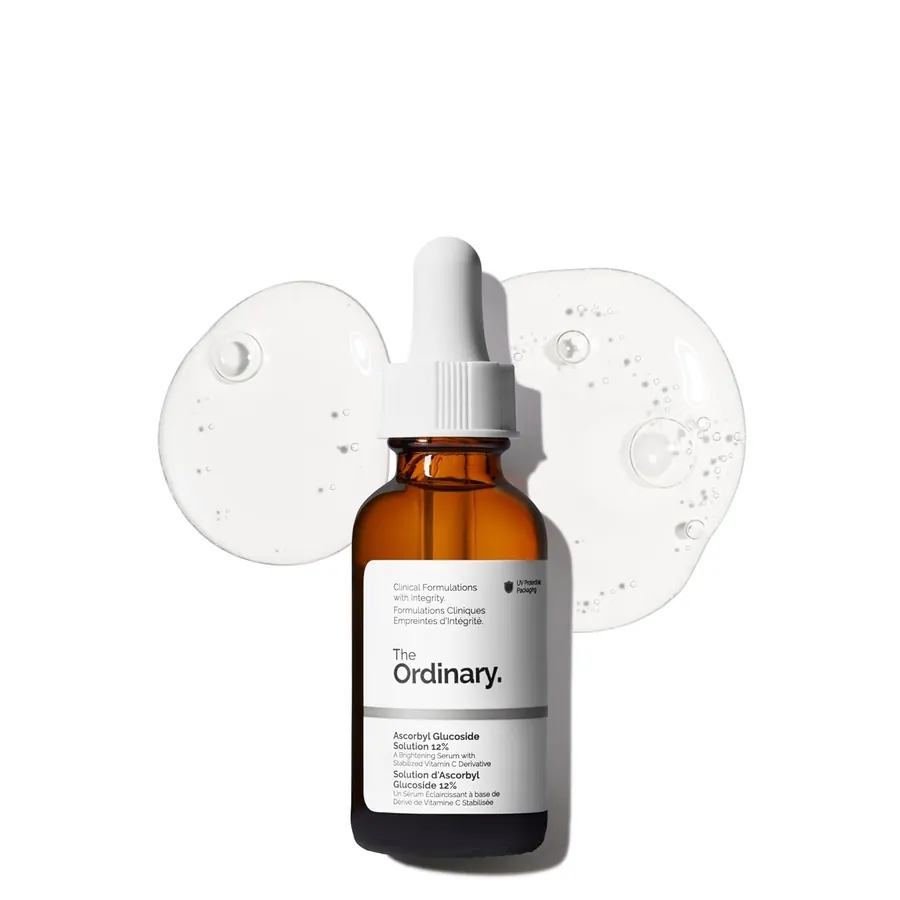
The bottle is a small amber glass dropper. Amber glass slows oxidation compared to clear plastic. The dropper dispenses one to two drops per press, which is about the right amount for full face coverage. I did not love that the dropper tip is not sealed after purchase: you are relying on the cap to keep air out. A sealed pump would be better for an antioxidant serum. This is a packaging compromise The Ordinary has made across much of their line, presumably to keep costs down.
The consistency is watery, not gel-like. If you are used to traditional vitamin C serums that feel slightly viscous, this will feel thin. That thinness is by design: it absorbs before you apply SPF, and it layers under moisturizer without pilling. But it also means you need to wait the full thirty-second dry time before the next product, or you will dilute it before it can absorb.
How It Compares to Pure Ascorbic Acid Serums
If you are comparing ascorbyl glucoside to a 10-15% L-ascorbic acid serum, the results from pure ascorbic acid will typically show faster dark spot improvement in the first four to six weeks. The tradeoff is tolerability and shelf life. Pure ascorbic acid serums oxidize faster, require low-pH formulas that cause flushing and tingling for a meaningful percentage of users, and need more careful storage. For anyone with reactive skin, the ascorbyl glucoside approach is the practical one, and the results at three months are often comparable.
The higher-end market has SkinCeuticals CE Ferulic as the reference standard for pure ascorbic acid vitamin C. That formula adds vitamin E and ferulic acid to the mix, which stabilizes the L-ascorbic acid and amplifies its antioxidant effect. If you are weighing that formula against this one, I cover the ingredient-level comparison in detail in the The Ordinary vs SkinCeuticals CE Ferulic head-to-head. The short answer: the gap in efficacy is real, but so is the gap in price. Whether the jump is warranted depends on what your skin needs.
What I Liked
- Stable formula that does not oxidize in the first few weeks of opening
- Fragrance-free and very low on skin irritation even on reactive skin types
- Lightweight texture absorbs cleanly and layers well under SPF and moisturizer
- Accessible price point removes the cost barrier for consistent daily use
- Suitable for combination, sensitive, and barrier-recovering skin types
Where It Falls Short
- Results are slower than most reviews suggest, often requiring eight to twelve weeks before dark spot changes are visible
- Dropper packaging lets in air, which speeds oxidation once the bottle is opened
- No antioxidant synergists (vitamin E, ferulic acid) to amplify efficacy
- Not the right choice for deeper PIH or dermal-level hyperpigmentation
- Propanediol can trigger minor congestion in pore-prone skin types during the first few weeks

Who This Is For
You are a good candidate for this serum if your skin is sensitive or reactive enough to struggle with traditional vitamin C, you are dealing with superficial post-blemish marks or general uneven tone rather than deep discoloration, and you are already using SPF daily. You need to be the kind of person who will stick with a routine for ten to twelve weeks without expecting visible change at week four, because that is the realistic window. If those conditions describe you, this serum does the job it promises at a price that removes every excuse not to use it.
Who Should Skip It
Skip this if you are chasing fast results on significant hyperpigmentation. The serum is not equipped for deep post-acne scarring, melasma, or stubborn discoloration that has been present for more than a year. For those concerns, a higher-strength L-ascorbic acid formula, a prescription retinoid, or a targeted treatment with azelaic acid will move the needle faster and with more documented evidence. Also skip this if you tend to get congestion easily and have not patch tested: the formula's propanediol content is a known pore-congesting trigger for a subset of oily skin types. And skip it if you will not commit to SPF use while taking it, because vitamin C without sun protection is a frustrating exercise in undoing your own results.
Consistent SPF users with reactive skin and surface-level hyperpigmentation: this is likely the most practical vitamin C serum at any price point.
The Ordinary Ascorbyl Glucoside Solution 12% is available on Amazon. With 4.6 stars across more than 2,200 reviews, the consensus holds up for the right skin profile.
Amazon Check Today's Price on Amazon →